
What is Swept Path Analysis?
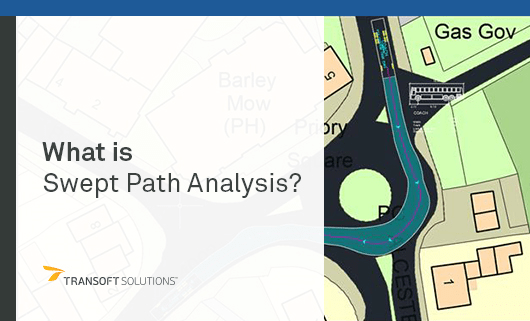
Swept Path Analysis is the evaluation and calculation of the space required when a vehicle makes turning manoeuvers. Its purpose is to help ensure designs (such as roads, driveways, site developments or parking facilities) can accommodate vehicle needs during operation, or to ensure that specific design vehicles can manoeuvre through selected routes. Although commonly referenced as ‘analysis’ or ‘checks’, swept paths analysis (as known as turn simulations) are a pre-cursor to many design elements and influences geometric design. For example, designs such as kerbs returns, junctions, road markings, parking spaces and loading/unloading facilities can benefit from proper analysis of vehicle swept path.
Who uses Swept Path Analysis Software?
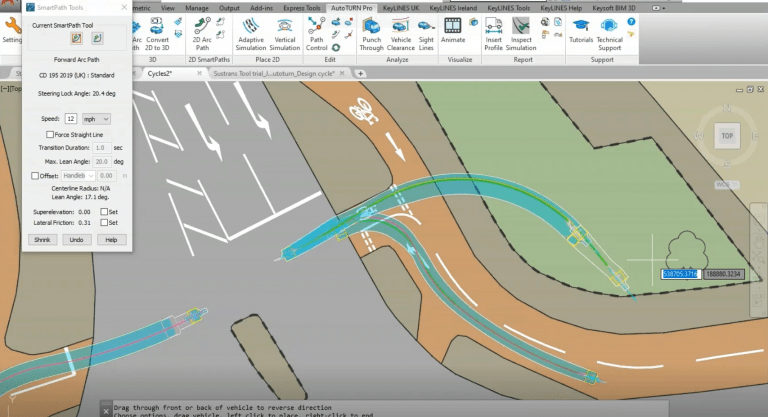
Professionals with varying levels of skill and experience, who work across many different industries and company sizes, can find value in swept path analysis software.
Whilst swept paths are a critical component of geometric on-street design, they are commonly used in many other environments too; such as inside of buildings to cater for accessibility, for planning of light rail schemes, to plan aircraft land movements, to layout construction sites and even in landscape design to plot routes for vehicles around planting and other softworks areas.
What are the Benefits of Swept Path Analysis Software?
There is an understanding that swept path analysis is difficult, if not impossible, without the use of custom software. Powerful design software gives designers and engineers the tools to not only portray an accurate depiction of what a project’s result will look like, but also a proposal on how the swept path scheme will be constructed. It can also help with project collaboration and make it easier to ensure that issued drawings comply with office and project standards.
When Should Swept Path Analysis be Performed?
To determine (and to justify) whether swept path analysis should be performed, it is helpful to consider the following types of questions:
Do large vehicles need to be accommodated on a regular basis?
Are vehicles likely to encroach upon pedestrian space?
Can two large vehicles pass each other side by side on a curve?
Is it likely that vehicles would need to use reverse gear for long distances?
Is it likely that a vehicle could only exit onto a street by moving backwards in reverse gear?
Do multiple lanes exist within a junction design?
Can large vehicles pass through a junction considering all allowable movements?
Is space used conservatively enough to avoid smaller vehicles manoeuvring at excessive speed?
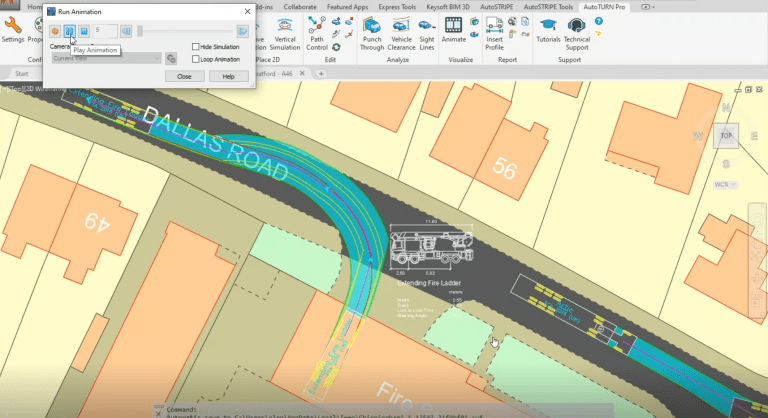
In the video below you can see how Swept Path Analysis is done with AutoTURN
What are the Uses for Swept Path Analysis Software?
The versatility of swept path analysis software means it can benefit organisations of any size working on projects of any scale. Here are some scenarios where swept path analysis could be used to benefit a project:
Residential:
Parking spaces would be designed to accommodate large standard cars
Refuse and recycling vehicles would access the development on a regular basis
Buses may need to be accommodated on primary local and connector roads
Retail and Industrial:
Facilities would need to be served by delivery vehicles, likely both rigid and articulated
Vehicles would need access to specific loading points and would be expected to perform low speed reverse manoeuvres
Schools and Education:
Access would be needed for buses and coaches as well as large delivery vehicles
Vehicles would require sufficient space to reduce the need for reversing manoeuvres
There would be a need to accommodate a high frequency of smaller passenger vehicles (cars). It would be important that the space and layout is enough for any larger vehicles but would equally not allow excessive speed for smaller cars.
Special consideration would be made to reduce opportunity for vehicles to encroach upon pedestrian areas
Highways and Junctions:
Vehicles should not encroach onto areas set out exclusively for pedestrians or cyclists
Vehicle speed is an operative factor in junction design and swept path analysis is leveraged to define speed controlling geometry
Designers should also consider the location and vehicle mix related to the junction
Specialised Vehicles and Abnormal Loads
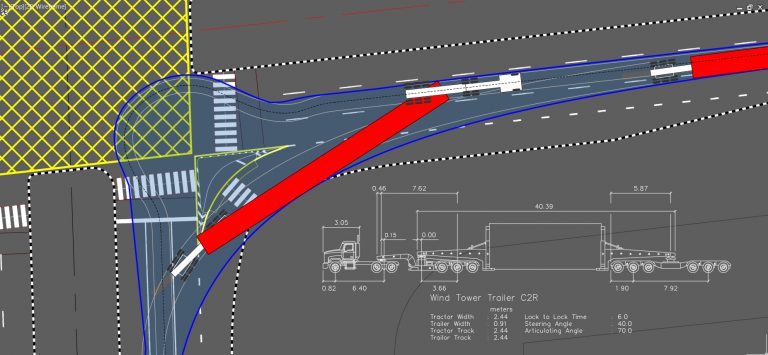
Abnormal loads are loads that are very low in frequency but challenging in size, shape or weight. Examples include moving wind turbine components to remote sites for erection, transporting large construction or military machinery by road or moving modular building or structural components into place. Importantly, Abnormal loads may be long, tall, wide or they may be of a non-challenging size but extremely heavy. Due to these factors, a specialist consultant will normally be contracted with experience in performing swept path analysis on such projects, or more commonly the transport and logistics company will have capability to perform simulations internally.
Deciding whether to undertake swept path analysis and purchasing appropriate software to accomplish this is not an easy decision. Depending on your scenario or role, the number of variables to consider can be large; everything from 3D visualisation functionality to the bandwidth of your design team can have an impact on your results and competitive edge.
To learn more about what options exist for making your swept path design processes easier or more detailed, speak to one of our knowledgeable sales team who will be more than happy to help.